Coming Out the End of the Tunnel

Well, it is done! Actually, it was done a couple months ago, but it has taken me awhile to wind down. I suppose it’s something like the bends – you can’t just go from 80-hour weeks to “normal life” in a weekend. Or, at least, I haven’t learned how to do so.

We’re not quite done yet, either – we’ve got at least one more important patch coming, with some memory optimizations and connectivity fixes. However, it’s probably about time to get a little reflective. I’ve been working on Civ games for five of the last six years of my life, and when I came on board at Firaxis, I don’t think I had any idea what was possible for the series. I loved, loved, loved Civ I – it was basically the only game I played in college – and I had a ton of ideas for how to improve the game when I arrived in Maryland in early 2000.

Most of the ideas, I’m afraid to say, were terrible. It took a lot of time to learn how to design in the Civ universe – a love of history and enthusiasm for games was definitely not enough. The parts of Civ which have always worked are the parts that are most transparent – that the player can keep in his or her head the easiest. It goes without saying that simplicity is important, but so is consistency.

For example, the appearance of Great People in Civ4 was originally going to be a random event based on certain factors, somewhat akin to how Military Leaders were created in Civ3. The problem is that the user is not in control – there’s a secondary layer separating them from the actual game mechanics. For some titles, that type of indirect gameplay is ok, even desirable. Civ, however, has a tradition of “boxes filling up with stuff” and following that tradition was one of the reasons culture worked well in Civ3. Thus, we wised up and follow that model in Civ4 – once a bar fills up with Great People points, Shakespeare (or Michelangelo or Einstein) is born. Players can now strategize how to get the most Great People and from which cities and how soon and of what type and so on.

At any rate, it’s been a long process, not just understanding what ideas work but also what type of ideas work for Civ. I’ve been wrong more often than I’ve been right, but fortunately there has always been an abundance of good feedback available, from our internal play session to closed beta testing to the general forums. I could have never designed Civ4 without it.

Here’s a few links from the last few months that might be of interest:
Gamespy Interview looking back on the game’s successes and failures
Planet Civilization Interview on the testing process (conducted by Thamis, one of our beta testers)
Eurogamer feature from my press tour through Europe with Sid

And I hope you’ll forgive me for this, but I just have to share. Civ4 came from so many people, from the team to all our fans, from Sid and Jeff to my family – and I am so thankful.
That’s SO Punk Rock!

I love this crazy Japanese cube game

I’ve always had a soft spot for minimalist music, both classical and not. I’ve never seen a game I would describe as minimalist, but there you go. In 100 years, when we’re all playing Mario 4096, that little flash app will STILL be fun. There must be something hard-wired into the human psyche (or, at least, my psyche) about evading predators, like little red cubes.

The really odd thing about the game is that it is actually deterministic. I didn’t notice it at first, but the pattern of the chase is always the same, which actually leads to (a little) high-level strategy. I keep getting killed in the upper-left corner at 20 seconds, so I do my best to remember to keep low after the 15 second mark.

Still, it’s begging for a random version. Is one available? Anyone know Japanese?

Are Games Movies… or Cars?

Like everybody else, it seems, I’ve been playing some Battlefield 2 recently (which, I must say, is a very strange name for a third game in a series – I guess Battlefield:Iraq wouldn’t fly?) At any rate, it’s an excellent game, a big step up from BF:Vietnam.

What I find most interesting about the game is that it is so obviously not a brand new product. The graphics and subject matter are both compelling enough that it’s going to hook plenty of new players, but most of the innovations (the squad system, saved ranks/medals, tank/anti-tank/special forces balance, the simple but effective fatigue model, etc.) are clearly built upon years and years and years spent developing exactly the same game over and over again. Simply put, Battlefield 2 is so much fun because the people at DICE really knows what they are doing.

Which, as a game designer, begs the question: could I possibly make a game that could compete with Battlefield 2? Could they make a game to compete with Civ 4? I am constantly being reminded by the fans about all the details they expect from a Civilization game. Hitting F1-12 should open AND close the Advisor screens. There must be SEPARATE options for quick attacks and/or defends. Sometimes they’d like to watch all rival moves and sometimes only enemy moves. Yes, double-click may select all units in a tile, but what if one just want to select all the workers? I don’t envy the next guy who has to remember all of this.

It’s not the ’80s anymore, when EA seemed to reinvent gaming each Christmas. (Dude.) Nowadays, a game like San Andreas is described as innovative, even though it’s the FIFTH game in a series. However, it’s possible that, in 2005, “innovation” is really beside the point.

The old, hoary games-as-movies analogy always breaks down because – in gaming – the sequel is often better than the original. I’d like to present a better analogy: games-as-cars. In the auto industry, the “genres” are pretty well established (sedans, trucks, cycles, minivans, etc). Much of the significant progress is technical (gas mileage, horse-power), and design improvements are usually of the tweak variety – a volume knob for your steering wheel! Every once in a while, a new hybrid emerges (SUVs), but it’s usually some variation on earlier ideas.

OK, so every analogy has holes, but I think this one is most relevant in terms of developers. Car companies are usually known for one type of car – I’m not going to be buying a Porsche truck anytime soon. Each car class has thousands and thousands of details that prevent creating new models out of whole cloth. Computer games have reached that point of complexity – it is becoming prohibitively difficult to just dip a toe into a new genre or style. Is it that hard to guess what’s coming next from Bioware? from Rainbow? from Rockstar? from Insomniac? from Ensemble?

er, nevermind. Well, let’s check back in three years and see how THAT turns out.

E3

So, I made it out to my first E3. It wasn’t quite as loud and crazy as I expected it to be – although that may be my perspective from having a nice, cool, quiet room to give our Civ4 demos. With the biggest plasma TV screen I’ve ever seen. It must have about 70″ – I heard it cost upwards of $25K.

Giving the demos was a more fun than I expected, especially once I got my rhythm down. It actually reminds of what I learned about writing in college; writing is only difficult when you don’t actually have something interesting to write about. Demoing Civ4 was easy because there is so much to show. Even with a 30 minute demo, we were only revealing a small fraction of the game, let alone all of the stuff you can’t really demo (multi-player, mod support, micromanagement fixes, improved AI, etc).

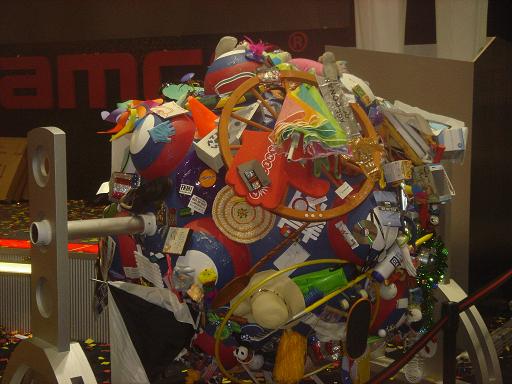
katamari.JPG

As for the show, I’d like to say I saw something that blew me away, but I didn’t. (besides the real-life Katamari ball!!!) Graphics are starting to hit diminishing returns. Most of the first-person games look the same, and the bloom shader has definitely lost its initial, er, shine. Interesting game-play? E3 is not the best forum for that. (I loved Prince of Persia but was put off by the “hardness” of the sequel. The only thing I discovered about the newest version was that it would be “bigger and badder than ever.” Gee, thanks…)

Age of Empires III did look incredible, especially the water, which may be the most beautiful thing I have ever seen in a game. (Naturally, they have a programmer working full-time on it.) The shading and choice of color is remarkable. I actually expect the art world to take notice. The game could be fun too – impossible to tell from a quick demo, of course. The trick will be whether they’ve learned from the “more is less” problems of Age of Myth (that game would have been twice as good if all human units had been removed). Rise of Legends also looked remarkably good for a game a full year out – I assume Microsoft won’t let them release until x months after AoE3. Somehow, the graphics retained the “fun-ness” of 2D while still being 3D, which is a neat trick. Steampunk is going to be a hard sell, though.

Hello World!

So, here we go!

This is the first post of my game design blog. My name is Soren Johnson, and I am currently the Lead Designer of Civilization 4. I’d like to use this forum to publish designer notes based on the games that I have worked on.

The name “Designer Notes” comes from my nostalgia for the days when every game manual came with a hefty designer notes section in the back, in which the developers spun tales, explained decisions, and generally provided a window into the design process.

I hope to do the same here. Indeed, I’d like to get into the nitty-gritty; I might even start talking about numbers if I get carried away. Thus, a familiarity with my games will almost certainly help the reader. So, go out and buy Civ3! And Civ4 in 7 months! And if you are really hard-core, go find a copy of Knockout Kings 2000 (PSX). If the AI kicks you in the groin, you’ll experience my first contribution to the game industry!

At any rate, this site will probably lie dormant for a while – there’s not much I can talk about Civ4 publicly yet, but be sure to check back later this year.