GD Column 18: The End of Games?

The following was published in the May 2011 issue of Game Developer magazine…

In a GDC speech from March 2010, ngcomo’s founder Neil Young described the advent of free-to-play gaming in the West as “the most significant shift and opportunity for [game developers] since the birth of this business.” Since then, more and more game developers are making this transition.

In June, Turbine announced that it’s profitable, subscription-based MMO Lord of the Rings Online would adopt a free-to-play model, based on the success of a similar change with their MMO Dungeon and Dragons Online, which increased the game’s revenues five-fold. In November, EA announced Battlefield Play4Free, a downloadable, free-to-play shooter built on the Battlefield 2 engine, meant to improve on the success of the similar, WW2-based Battlefield Heroes. In February of this year, Riot Games, developer of the popular free-to-play strategy arena combat game League of Legends, was purchased by Chinese games behemoth Tencent for $400 million, signifying the massive revenue potential of the format.

Indeed, few major franchises are not being considered as raw material for a transition to free-to-play; the revenue potential is simply too large to ignore. In March, at the Bank of America Merrill Lynch 2011 Consumer Conference, Activision CFO Thomas Tippl stated that, shockingly, Starcraft 2 was not worth the effort from a financial perspective. Although the game sold very well, grossing over $250 million dollars, the lack of any ongoing revenue coupled with the high development costs meant the final return on investment was simply not high enough. Ultimately, publicly-traded companies, like Activision, must invest their money in projects with the highest potential profit margins and, increasingly, free-to-play games are beginning to dwarf single-purchase games in that regard.

Neil Young’s own ngmoco provides an interesting example of how this shift can change a company’s priorities. The smartphone developer’s first major hit was Rolando for the iPhone, providing the young startup with its first major revenue stream. However, ngmoco soon discovered that although they could make modest profits on singe-purchase mobile games, their most profitable releases were free-to-play games built with in-app purchases. Within a month of release, their kindgom-builder We Rule became the highest grossing “free” game on iOS devices.

Understanding that free-to-play games would be the only way to scale their business, ngmoco cancelled single-purchase games, including the guaranteed money-maker Rolando 3, in favor of games which fit the freemium model. In Young’s words, “If we can’t make the game free-to-play, we’re not going to release it.” The strategy worked as his young company was purchased by the Japanese social gaming giant DeNA in late 2010 for an impressive $400 million.

A New Design

Today’s game designers will increasingly hear similar mandates from their own management teams. However, shifting to free-to-play design is not a straightforward process. Indeed, designers of single-purchase games have a much easier job as they only have to focus on one thing: making the player’s experience as much fun as possible. In contrast, designers of free-to-play games must make the game engaging enough to attract and retain players while also holding back enough of the experience to drive microtransactions.

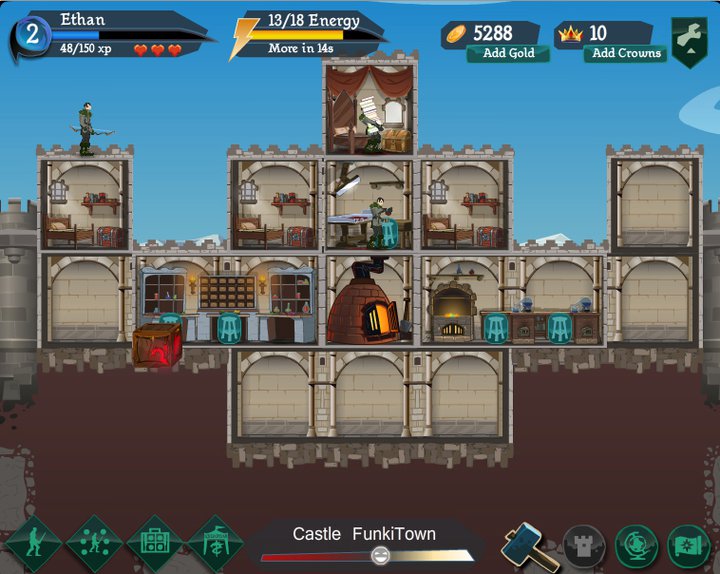
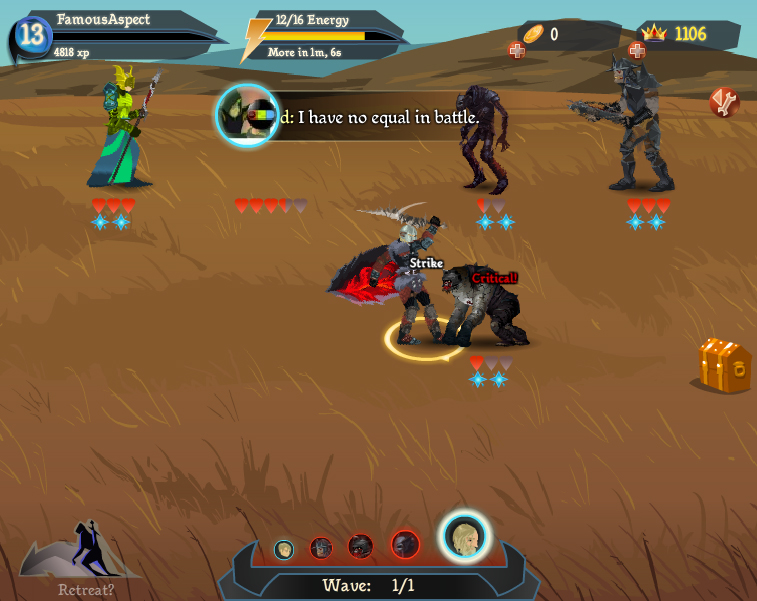
The energy model is a proven mechanic that maintains this balance for many free-to-play games, including my own Facebook-based RPG Dragon Age Legends. Under this model, certain player actions, such as starting a battle in Legends, consume a set amount of energy. Once a player uses up all of her available energy, these actions are unavailable until the energy regenerates, commonly at the rate of one point every five minutes.

Thus, with a full energy bar, the player can typically fight four or five battles before getting stuck. At that point, he can either decide either to let the energy recharge naturally, which might take two hours for an empty bar, or to purchase an instant refill with real money. While they still have energy remaining, free players have access to the full game experience – the battles in Legends do not work differently for paying players – but they have to deal with some impatience after they hit the energy gate.

In single-purchase games, designers would rarely build a game mechanic that intentionally tests the player’s patience; in fact, that is a hallmark of bad game design. Thus, free-to-play games upend many of the assumptions that designers bring to the table from traditional single-purchase design. Indeed, this break is creating a great deal of anxiety within the game design community as many developers feel that their original motive for making games – to bring players as much fun as possible – is now in danger. Noted independent designer/programmer Chris Hecker recently echoed his own concerns:

The problem I have with free-to-play is business types rarely talk about what you’re giving up by going to that model.  Microtransactions warp game designs, not necessarily for the better or for the worse, but they certainly make the designs different. If the profitability of microtransactions makes it so most companies go towards this model with their big-budget titles, then that is a shame and a loss, because there are lots of designs that are interesting and important to the art form to explore, but that don’t lend themselves to microtransactions and free-to-play. I hope single-purchase, “complete experience” games don’t go away; not because I’m old and curmudgeonly–although I am–but because there is an entire subspace of game design there that still needs to be explored.

A New Hope

League of Legends, one of last year’s most successful strategy games, provides an interesting case study which ultimately shows that Hecker’s primary concern – the design space explored by single-purchase games could be lost – is valid. The game is commonly held up as the best example of free-to-play design done right. Not only has League of Legends been both wildly popular and commercially successful (see the $400 million purchase above), the game has also garnered critical acclaim, sweeping the first-ever Game Developers Choice Online Awards. Most importantly, however, the game’s business model has been accepted peacefully by the core gamer community, one which typically views microtransactions with suspicion.

Because Leagues of Legends is a highly-competitive, team-vs-team arena combat game, microtransactions which could give one side an advantage over another would be wholly unpalatable to a large portion of the Western audience. Instead, the game only hands out bonuses to players who have invested large amounts of time in battle.

The meta-economy employs a dual-currency model common to many free-to-play games, with a time currency (IP) which is earned through play and a cash currency (RP) which is bought with real money. Items which can boosts a player’s abilities (Runes) can only be purchased with the time currency (IP), providing players a strong incentive to keep player to earn more IP. Cosmetic items, which only change the player’s appearance, can only be purchased with the cash currency (RP), which simply appeals to a player’s pride or vanity.

The player can also buy a temporary boost with RP which increases the rate IP is earned. This microtransaction present a time-vs-money question to the player; she can spend some money now to earn Runes faster, or she can simply play some more games to earn the extra amount of IP required.

Still, the most interesting microtransaction is the character unlocks. League of Legends descends directly from the popular Warcraft 3 mod Defense of the Ancients, in which the player gives up control of an army of units for control of a single hero. The mod’s depth came from the different combination of hero types – 103 in the current version. League of Legends has a similarly large stable of “champions” – 72 as of March 2011.

However, these 72 champions are not all available at all times. Instead, a rotating selection of around ten are available each week, which means that players have only limited control over which champion they can use. This cycle can greatly upset a player who has become quite good with a specific champion but who must now learn a new one. Some players enjoy the challenge of mastering a new set of skills and attributes, but many others prefer to keep winning with a champion that works for them.

Accordingly, League of Legends gives players the option to unlock champions permanently, with either IP or RP. Like the energy mechanic common in social games, the character unlocks are charging players for their impatience. Can they wait weeks until their favorite champion is again available for free or days until they earn enough IP to buy the unlock, or will they just spend some real money right now to get back into the action with their favorite character? This model works well for both gamers, who are getting an incredible experience for free, and for the developer, who can rely on player impatience to generate revenue.

Nonetheless, single-purchase games would never be designed this way, with players limited to a small sub-set of possible characters each week. (Indeed, the single-purchase strategy game Command and Conquer 4 was roundly criticized for forcing players to “earn” the right to build certain units over multiple play sessions.) Although League of Legends could make the transition to a single-purchase game by simply unlocking the majority of champions immediately, not all single-purchase games could just as easily make the transition to free-to-play.

For example, StarCraft 2 is not so easy to imagine as a free-to-play game. The franchise is a model of a tight, elegant ruleset, with no extraneous parts or redundant options to muddy the design. Indeed, even with the new units added for the sequel, Blizzard removed enough old elements to keep the unit count down near the original 12 per race. Indeed, few reviewers even felt the need to comment on the lack of a fourth race to differentiate the two versions.

Could StarCraft 2 follow the League of Legends model? Perhaps Blizzard could allow everyone to play the Terrans for free but only offer the Zerg and the Protoss to paying players? This model would probably fail both for business reasons (not enough opportunity for repeatable purchases) and for design reasons (having 90% of the players forced to use Terrans would destroy the balance). Anything more aggressive – like actually selling extra siege tanks during battles – would violate the concept of a fair playing field, a core tenet for strategy games.

An Old Lesson

Thus, if Activision believes that making a game of StarCraft 2’s scope is not worth the effort, will this type of tight, intricate design simply disappear? Although microtransactions are still relatively new in Western video games, they are not new for physical games in the West. The emergence of Magic: The Gathering and other collectible card games (CCGs) in the ‘90s showed the power of microtransactions for encouraging players to make recurring purchases within the same game system over many years. The makers of CCGs have been dealing with this new world which necessarily mixes business and game design at least a decade before us.

However, the wild success of CCGs – Magic still regularly grosses over $200 million yearly, which dwarfs non-collectible card games – did not send single-purchase, “complete experience” physical games into extinction. Indeed, the card and board game industry is more diverse and innovative than ever before.

In fact, two of the most successful card games of the last few years have taken a mechanic directly from Magic, adapted it to fit the format of a single-purchase game, and found commercial and critical success. Dominion turned the meta-game of a CCG into a traditional card game by having players build and play a deck of cards during the game. 7 Wonders turned drafting, a folk method for distributing CCG cards, into a game by conducting a single draft after each individual card play.

These examples of successful single-purchase games emerging from the shadow of Magic prove this format can still thrive in a world with microtransactions. Indeed, these designers brought some of the gameplay of Magic to a new audience simply because not everyone is ready to buy only a small part of a card game, which will never be complete. Many gamers will never be ready for CCGs, just as many gamers will never be ready to spend money on a free-to-play game.

Thus, if every video game adopts microtransactions, many players will be left behind who are looking for a different type of experience. Microtransactions DO warp the game design towards a model that supports recurring purchases. However, this shift leaves a great deal of space behind as a vacuum ready to be filled by smaller publishers and developers who are looking for great opportunities. The profits from single-purchase games can easily justify the development costs for teams that take their budgets seriously, and these profits can only go up as more and more big publishers abandon this still fertile design space.
GD Column 17: Water Finds a Crack

The following was published in the March 2011 issue of Game Developer magazine…

“This is what games are for. They teach us things so that we can minimize risk and know what choices to make. Phrased another way, the destiny of games is to become boring, not to be fun. Those of us who want games to be fun are fighting a losing battle against the human brain because fun is a process and routine is its destination.”

– Raph Koster, A Theory of Fun

Many players cannot help approaching a game as an optimization puzzle. What gives the most reward for the least risk? What strategy provides the highest chance – or even a guaranteed chance – of success? Given the opportunity, players will optimize the fun out of a game.

Games, however, are so complex that it is difficult to anticipate exactly how players will optimize a game until after release, once thousands bang away at the game and share their ideas with each other online. Often, designers don’t even understand their own games until they finally see them in the wild.

A phrase we used on the Civilization development team to describe this phenomenon is that “water finds a crack” – meaning that any hole a player can possibly find in the game’s design will be inevitably abused over and over. The greatest danger is that once a player discovers such an exploit, she will never be able to play the game again without using it – the knowledge cannot be ignored or forgotten, even if the player wishes otherwise.

Civilization 3 provides a simple example with “lumberjacking” – the practice of farming forests for infinite production. Chopping down a forest gives 10 hammers to the nearest city. However, forests can also be replanted once the appropriate tech is discovered. This set of rules encourages players to have a worker planting a forest and chopping it down on every tile within their empire in order to create an endless supply of hammers. However, the process itself is tedious and mind-numbing, killing the fun for players who wanted to play optimally.

Tank-Mages and Infinite City Sleaze

One of the dangers of players looking to optimize a game is that a single dominant strategy will emerge that drowns out all others. In the MMO world, the shorthand term for this predicament is the “tank-mage” – a reference to Ultima Online, in which certain hybrid class builds could both wear heavy armor and cast powerful damage spells.

Thus, the character served as both the damage absorber (the “tank”) and the damage dealer (the “mage”), displacing most other possible character builds. Almost every MMO has experienced some version of the tank-mage as players try to find the optimal build for all situations.

The Civ series has its own version of the tank-mage – the strategy of spamming settlers for “infinite city sleaze” (or ICS), a bane of the franchise from the beginning. The essential problem is that 50 size-2 cities are more powerful than 5 size-20 cities as a number of bonuses are given out on a per-city basis. For example, every city gets to work its home tile for free, which means that a size-2 city works 3 tiles with only 2 citizens (1.5 tiles per citizen) while a size-20 city works 21 tiles (only 1.05 tiles per citizen).

The problem is that while ICS makes beating the highest difficulty levels trivially easy, handling 100 cities is a management nightmare. Players who pursued this strategy – or even less extreme versions of it – were always aware that they were breaking the game but often simply couldn’t stop themselves.

Armed with knowledge from the earlier versions of the game, we were able to counter ICS ahead of time with Civ 4 by adding a per-city maintenance cost that scaled with the total number of cities. Thus, building too many cities too early crippled a player’s economy, killing ICS at long last.

The reason to kill tank-mages and ICS is that a single, dominant strategy actually takes away choice from a game because all other options are provably sub-optimal. The sweet spot for game design is when a specific decision is right in some circumstances but not in others, with a wide grey area between the two extremes. Games lose their dynamic quality once a strategy emerges that dominates under all conditions.

Undervaluing Time

When presenting players with a choice, games typically pair a specific reward with a certain level of risk. When gamers discover that one play style offers a trickle of reward for little or no risk, they will inevitably gravitate towards that degenerate strategy.

In other words, players will trade time for safety, but they risk undervaluing their own time to the point that they are undermining their own enjoyment of the game. A classic example is the skill system from Morrowind, which rewards players for repeating any activity. Running into a wall for hours increases the Athletics skill while jumping over and over again increases the Acrobatics skill. Many players couldn’t stop themselves from spending hours doing mindless activities for these cheap rewards.

Another example of players undervaluing their own time comes from growth, production, and research overflow in the Civ series. Every turn, cities produce food, hammers, and beakers, filling up various boxes. Once these boxes are full, new citizens, buildings, units, and technologies are created.

For example, if a civilization produces 20 beakers per turn, and Writing costs 100 beakers, the technology will be discovered after 5 turns. However, if the same civilization produces 21 beakers per turn, the box for Writing will contain 105 beakers at the end of 5 turns. In that situation, after Writing is discovered, the extra 5 beakers are thrown away so that the box will be empty when the player starts researching Alphabet on the next turn. Players quickly realized that when they came close to finishing a tech, they could adjust their tax rate so that no beakers would be wasted (because those beakers are all potential gold at a different rate).

A similar dynamic exists with food and hammers for city growth and production. Thus, the game’s rules encourage players to visit every city every turn to rearrange their citizens to ensure no food or hammers will be lost. This micro-management is actually a somewhat interesting sub-game, but clearly not how the designers want the players to be spending their time as it completely bogs down the game. (We solved this in Civ 4 by simply applying the overflow food/hammers/beakers to the next citizen/unit/building/technology.)

Players who adopt this strategy often refer to the game as being heavy on “micro-management” because they can no longer resist playing the game without squeezing every last drop out of their cities. The problem is even worse in multiplayer as gamers who don’t micro-manage their cities will always fall behind in the race for more growth and production.

The designers don’t want people to play this way; nonetheless, the rules inadvertently encourage it. Again, designers often don’t understand their own games as well as the players do. The problem with a gamer undervaluing his own time is that, while the easy rewards may feel good at first, eventually the amount of time required will slowly seep away the fun per minute, until the game begins to feel like a grind.

Good Exploits?

However, designers can go too far by trying to remove all exploits from a game. Often, the right choice depends upon the game’s context. Does the exploit drown out all other play styles, or is it a fun, alternative way to play? Does the degenerate strategy create an endless grind, or is it a quick shortcut for players who need a little help?

The famous, endless free lives trick from Super Mario Bros. – in which the player bounced a turtle shell repeatedly against a block staircase for long strings of 1UP’s – was actually not a bug but a feature the team included on purpose. In exchange for mastering a small dexterity challenge, players can quickly mine all the free lives they need to progress in the game. Discovering and abusing a hole in a game’s design can be a fun experience – giving the player a unique sense of mastery – as long as the exploit doesn’t ruin the game for the player (or the player’s opponents).

If possible, designers should provide the ability to turn an exploit on or off, giving the players control over their worst instincts. For example, most games with save/load functionality can be abused by players to improve their odds; an RPG in which smashing a box produces random loot can be reloaded as many times as necessary until the best possible weapon or armor appears.

With Civ 3, we introduced a feature that preserved the game’s random seed in the save game file, guaranteeing that individual combats would play out the same way regardless of how many times the player reloaded the game. No longer were players tempted to reload every bad combat result, which could slow the game to a crawl.

However, the community response was not what we anticipated. Although some players appreciated that they were no longer tempted to reload combats, many others were frustrated that one of their old tricks disappeared. Indeed, some angry fans actually felt that the game was cheating on them by always reproducing the same combat result!

We solved this problem by turning this feature into an option on game start. Players who want the chance to reload a particularly unlucky roll can use the old exploit, but the game, by default, discourages this work-intensive strategy. Ultimately, the designer can’t go wrong putting the player in control of his or her own experience.

Dragon Age Legends: Guilds Explained

My current game, Dragon Age Legends, was released last month. I wrote the following post as designer notes on the upcoming guild system.

One of the design goals of Dragon Age Legends is to have meaningful social mechanics. Many social game are social only in the sense that they use the player’s social graph to help spread the game virally through her network – by encouraging the player to invite her friends as neighbors to grow her farm, for example, or trading items with one another through the gifting system to finish a building. While these mechanics help grow a social game’s visibility, they don’t necessarily make the actual experience of playing the game more fun.

Our core social feature in Legends is borrowing friends’ characters to fight alongside one’s own character in combat. As one’s friends level up their own characters, they make the game more fun by providing new skills and stronger characters to use. Unlike most RPGs, players of Legends will be able to try out the entire skill tree depending on how their friends upgrade their characters. Borrowing a friend’s character also provides that friend with a small gold bonus, which creates some interesting dynamics – encouraging players to have the most appealing characters (to earn more gold) while also giving veterans a charitable reason to bring along low-level friends they want to help.

However, a genuinely meaningful social mechanic can create its own share of problems. Facebook friends are not necessarily one’s actual friends. Players often announce their names and character details in various forums, hoping to find “fake friends” to fill out their list. Doing so creates three advantages. First, the more friends the player has, the more opportunities for his character to be borrowed and thus earn friend gold for the player. Second, high-level friends make combat far easier because of their high stats and upgraded skills.

Finally, a surplus of friends allows the player to bypass the rest time restriction. Borrowed characters enter a rest state after combat finishes for a certain period of time (often for a few hours, depending on the level and damage sustained). This rest period exists so that players will not be able to reuse a single friend’s character over and over again (and, thus, feel no incentive to invite other friends into the game). However, if a player has a huge list of fake friends playing the game, perhaps numbering in the hundreds, this mechanic becomes irrelevant as there will always be a ready supply of fully rested characters.

These three advantages can greatly distort the balance of the game. In particular, if a player has a huge list of high-level friends, which is not difficult if one looks in the right places, the combat becomes trivially easy. High-level characters can wade through most monsters easily, which prevent us from finding an ideal difficulty level. We could boost the strength of all monsters across the board to compensate for endless high-level friends, but that change would ruin the game for the average player who only uses her real friends. Besides, we want the player to experience the power of a high-level friend mowing down waves upon waves of darkspawn from time to time, just not in every battle.

To fix this issue, we are creating a new system – Guilds. A Guild is a select group of 16 friends who are playing Legends. The player can only borrow characters for combat from this group of 16. The composition of a Guild can be changed at any time (as long as the character being removed is not currently resting), so a player is not restricted to whichever friends are first added to the Guild. Also, a new castle room – the Great Hall – will allow players to expand their Guilds.

Guild membership is one-way; I might have my friend Ethan in my Guild, but Ethan does not need to have me in his Guild. However, if we are both in each other’s Guilds, we receive a bonus of a shorter rest time when using each other’s characters. This feature creates some interesting social pressure, forcing players to choose between using their friends with the best characters and using their actual best friends.

From a design perspective, the greatest benefit of Guilds is tuning as we can now balance the game for a single target – a player who has 16 friends, with a mixture of low- and high-level characters. Because rest time is proportional to a character’s level, players might not want to fill their Guild with only high-level character who would often be unavailable.

Ultimately, the player should be making interesting decisions during all parts of the game, including when deciding which friends to use for combat. Perhaps a certain battle looks fairly easy, so a player might want to use a couple low-level friends or maybe to even try it solo. Perhaps a looming boss battle makes the player hesitant to waste his highest-level friend on a normal encounter. With infinite high-level friends, these dynamics disappear, to the detriment of the gameplay.

Moreover, we want players to be interacting as much as possible with their real friends, as these are the most important social bonds tying the player to the game. Guilds encourage this behavior via the reciprocal membership bonus to rest times as well as the simple ability to build a subset of friends most relevant to the player. Guilds are a small but important step towards creating meaningful and balanced social mechanics within Dragon Age Legends.

Podcast Campaign March 2011: No Mercy!

So, last month, I did a bunch of podcasts on Dragon Age Legends and the state of social and strategy games, in general. If you’ve got a spare six hours, I hope they are worth a listen:

Three Moves Ahead on Strategy Games

Gamers with Jobs on Dragon Age Legends

Jumping the Shark on Dragon Age Legends

The Digital Life on Dragon Age Legends

Dragon Age Legends: Economy Explained

My current game, Dragon Age Legends, was released this week. I wrote the following post as designer notes on the economy system.

Many successful Facebook games are persistent management games. In FarmVille, the player plants and grows a prosperous farm. In Millionaire City, the player designs and constructs a bustling city. These games give players a certain number of resources to spend on development and then reward their smart moves with more money to invest, creating a positive feedback loop. The money players earn enables them to buy more things that will earn them even more money for more things and so on.

While this mechanic forms the solid underpinning of most management games, it creates two problems for long-term, persistent play. First, as the gameplay is stretched over months (instead of a few hours in the case of non-persistent games like SimCity), the amount of interaction required for each visit is quite small – place a building here, drop a road down there, etc. Therefore, most social games add UI busywork to fill up the player’s time – plowing, seeding, and harvesting every plot for farming games or clicking on each energy, food, and wood icon that appears in FrontierVille. In actual time spent, these often mindless activities comprise the bulk of each play session.

Second, these games often lack a sense of purpose outside of simply growing the player’s ability to continue growing. If the only reason to earn more money is to invest in items that will earn more money, the game eventually loses players not interested in pursuing purely aesthetic goals. At some point, maintaining a city begins to feel more like clearing the weeds or doing the laundry than playing a game.

The turn-based combat of Legends solves both problems at once. The tactical battles occupy the majority of the player’s time within the game, and they are clearly not mindless click-fests, challenging the player and rewarding smart moves. Furthermore, the battles give the persistent castle an actual purpose; expanding the castle is not an end in and of itself. Instead, the output of the castle is consumables the player can use in combat: health potions, mana salves, shard bombs, and so on.

Indeed, the way consumable are handled in Legends is meant to improve on their use in traditional RPGs as well. Traditionally with these type of games, hoarding is quite common as the player is uncertain what is around the corner – what if she uses too many potions and will not be able to tackle the later game as the difficulty increases? Turn-based RPGs suffer even more as the player is usually choosing between a repeatable skill and a consumable item, which means that the power of the latter has to greatly outweigh that of the former to be worth the permanent loss of the item.

Legends solves this problem with a few simple changes. First, consumable use does not end a character’s turn; instead, it is an optional step. The character can either shoot an arrow or drink a potion and shoot an arrow. Thus, by passing up the use of a consumable, the player is forfeiting an opportunity and needs only to weigh the effect of the item versus its permanent loss.

Second, the game’s core stats, health and mana, do not regenerate as they do in most RPGs. Health does replenish but only outside of combat and only in real time – one point of damage per hour. As for mana, characters receive only one or two free points at the start of combat, enough to use a couple skills per battle. Thus, if players want to restore their health and mana, they need to rely heavily on their consumable items – health and mana potions, injury kits, and mana salves. As long as battles are balanced correctly, consumables become the fuel that players use to power though DAL’s combat.

However, Legends also differs from traditional RPGs because the player is actually in control of the supply of consumables, via the castle. The core of a player’s castle are the workshops – the apothecary (for crafting potions), the infirmary (for salves), and the alchemy lab (for bombs) – which can create consumables over certain timed increments. For example, the player can place a worker in the apothecary to create 2 health potions in 30 minutes of real time. Giving players this control frees them from the anxiety of depleting their limited supply of items. With Legends, players can always invest time and gold into their castle to start rebuilding their supply.

Indeed, the two halves of the game – the castle and the combat – create a self-sustaining economic loop. Gold earned from fighting battles and completing quests can be invested into expanding the castle and upgrading its rooms. Accordingly, maintaining the castle and tasking workers to create items provides the potions, salves, and bombs the player needs to defeat the increasingly difficult monsters encountered over the course of the game.

Thus, the two parts of the game fit together and buttress each other. A well-supplied character will lose less battles, earning more gold that can be invested in the castle. A well-maintained castle will create more consumables for the the player to use in combat, increasing the odds of success. The combat and the castle provide context for each other, motivating the player to keep fighting and to keep building.

Dragon Age Legends: Combat Explained

My current game, Dragon Age Legends, was released this week. I wrote the following post as designer notes on the combat system.

One of the most lauded features of Dragon Age: Origins was its tactical combat system, which encouraged players to plan ahead and make interesting choices during battle. Indeed, although the system ran in real-time, the player could set a number of triggers that paused combat, to give time for deciding which skills to use and against which enemies. This feature allowed some to play Origins as almost a turn-based game that emphasized smart tactics over fast reflexes.

The Dragon Age Journeys Flash game built in parallel with Origins brought elements of the franchise to an actual turn-based game, in which battles played out on a hex-based grid. For the new Dragon Age Legends Facebook game, we built on top of what worked within the Journeys system (which itself was based on Daniel Stradwick’s Monsters’ Den Flash RPG).

For example, we borrowed the interleaved turn queues from Journeys, which means that the heroes and monsters take turns one at a time instead of fighting together as alternating groups, as is common in many group-based RPGs. Giving the player knowledge of which exact characters will move next creates some interesting tactical decisions. A monster who will attack sooner might be a better target than one who is a greater threat overall. Skills which disable or freeze enemies can be used intelligently to keep the most dangerous monsters at bay.

However, we simplified other mechanics from Journeys. Instead of using a hex-based grid, we adopted a simpler layout familiar to fans of Japanese RPG series like Final Fantasy in which the heroes and monsters line up on opposite sides of the screen is static slots. We built a 2 X 3 grid for each side, with front and back columns so that characters in the back column are protected from melee attacks by characters in the front column. This arrangement allows players to plan ahead by attacking a specific monster in the front line that, when dead, would expose a weak but dangerous blood mage in the back.

Another big change involved how we handled health and mana, the two most common stats from RPGs. Instead of using a bar-based system, in which a character might have 45 of 80 health points, we adopted a more chunky icon-based system. A character’s health is represented simply by 4 hearts, which are measured in halves, identical to the health system from the Zelda games. Mana is represented by single icons and as most skills cost just one mana, the number of icons a character has is shorthand for how many skills she can use.

This simplification had a number of advantages. First, the system had much greater clarity than opaque health and mana bars. These bars generally have the same size on the interface for the sake of consistency, which unfortunately obscures their true values. Although one character might have 20 hit points while another has 200, their health bars look the same on the game screen. In fact, most modern RPGs have superimposed text on top of health bars to give the actual values to avoid any confusion. With the iconic hearts, Legends avoids this problem as the graphics do not obscure any game data – what you see is what you get.

However, the most important reason to adopt the icon system is that it gives players a very tangible understanding of the consequences of their actions; the interface tells the exact effect of every possible action. For example, mousing over the “Power Strike” skill button next to a Hurlock shows that the action will take one-and-a-half hearts away from the monster while draining one mana from the player’s character. Mousing over a health potion shows that two hearts will be restored to the character. Mousing over a shock bomb shows that one heart will be taken away from all enemies. This transparency enables the player to plan ahead and make smart moves.

One reason so many RPGs go with a bar-based system is that hits points need to scale up over the course of a game, ranging from 10 hit points for starting monsters to over 1000 for bosses. With icons, Legends can never support hit point values that scale so high because the interface can only show so many hearts. Instead, the underlying character stats – attack, defense, agility, and luck – provide the scaling we need as players progress through the game.

Damage is calculated by creating a simple ratio between the attacker’s attack and the defender’s defense values. As this ratio increases to 2:1, 3:1, and higher, the damage value in hearts goes up. However, if the ratio remains constant, so does the damage. Thus, characters battling with 10 attack and 8 defense do the same amount of damage as characters battling with 50 attack and 40 defense, which means that the relative value of hearts stays the same. Similarly, agility and luck determine the odds of glancing blows and critical hits, by comparing the attacker’s luck with the defender’s agility.

As for mana, most skills cost just one point, with a few costing two and a handful costing more. The skills are all upgradeable up to ten levels (similar to the Japanese RPG Etrian Odyssey), which means that their power increases over the course of the game. However, their costs do not, so that players can expect to use the same number of skills per battle through all phases of the game. The costs can remain fixed because the better skills are simply an extension of the character’s growing power as he levels up.

Thus, the game’s simple and discrete health and mana values are maintainable across the game’s various levels. The players quickly gain an intuitive sense for how the game works (“shard bombs do one-and-a-half hearts of damage”) without having to memorize formulas or manage large, crooked numbers. Being able to think in small increments – a point here, a couple of points there – allows the player to fit a whole battle into her head at once, making combat a fun, tangible experience instead of a chaotic, stressful one.

My Favorite Week: 2011 Edition

GDC 2011 start on Monday, and I am even more excited than normal this year because I helped program the conference. The GDC Advisory Board invited me to join them last summer, and it’s been very interesting watching how the sausage gets made. I’m looking forward to seeing which ideas and sessions work out and which ones don’t. (If you don’t like that the “fuzzy” sessions – the rant, the microtalks, and the challenge – are scheduled during lunch, you can blame me!) It’s been an honor to be part of the process – I am as much a GDC junkie as ever.

I’m taking part in one talk this year, a panel on strategy gaming, for which I hand-picked the members. Hope to see you there!

Strategy Games: The Next Move

SPEAKER/S: Tom Chick (Quarter to Three)Ian Fischer (Robot Entertainment)Soren Johnson (EA2D)Dustin Browder (Blizzard Entertainment) and Jon Shafer (Stardock)

DAY / TIME / LOCATION: Friday 11:00-12:00 Room 134, North Hall
TRACK / FORMAT: Game Design / Panel

DESCRIPTION: Strategy games have one of the longest traditions within the industry, including two of last year’s biggest games, STARCRAFT II AND CIVILIZATION V. In what direction is the genre heading? What are some of most important, and possibly overlooked, gameplay innovations of the last few years? How has the growth on online, persistent play affected the way strategy games are developed? Has the rapidly expanding mainstream audience changed how strategy games are targeted, or is the genre at risk of turning into a ghetto? As the market moves towards free-to-play, micro-transaction-based gaming, how will strategy gaming adapt while maintaining fairness of play? Is there still room for traditional, boxed strategy games?

TAKEAWAY: Several experienced strategy developers will share their own perspectives on the future of the genre, offering insights on both game design and the challenges facing the genre in the coming years.

INTENDED AUDIENCE: Although primary of interest to strategy game developers, the session will also be relevant to anyone interested in how a game genre evolves and reinvents itself in the face of a changing market.

GD Column 16: Stop Making Sense

The following was published in the December 2010 issue of Game Developer magazine…

Some of our industry’s most beloved games make precious little sense. Why, for example, do players battle the trolls, goblins, and skeletons of Puzzle Quest by challenging them to a two-player version of Bejewelled? Similarly, success in Professor Layton’s world seems to revolves disproportionately around one’s ability to solve classic logic and deduction puzzles, no matter the reason.

Game stories have fared no better. Mario’s canonical plot sounds like nonsense from Lewis Carroll – the plumber punches bricks to find magic mushrooms that double his size, so that he can battle an evil turtle who has kidnapped the kingdom’s princess. The less said about the Metal Gear Solid franchise’s various twists and turns – including the infamous possession of Revolver Ocelot’s mind by Liquid Snake’s old arm – the better.

However, games have their own internal logic that is more important than whether the game’s story makes sense, or even whether the game’s mechanics hold together logically, without bizarre juxtapositions like in Puzzle Quest. The traditional concepts of levels, lives, and respawns are ultimately constructs that support a designer’s vision, whether or not they have any logical real-world parallel or thematic metaphor.

Why, for example, should players respawn – coming back to life – after being killed in a team-based shooter? Shouldn’t players expect that their dead character stay dead after being killed? The reason is that the respawn mechanic matches the inviting tone the game’s designer wishes to strike. By softening the blow of death, gamers are free to play aggressively, which rewards risk and even experimentation.

A place exists for games which do not allow respawning – Counter-Strike being the most successful example – but the designer chooses this mechanic not in pursuit of realism, but to strike a different tone. When characters stay dead, players feel more tension during the match, which encourages them to play more carefully and with greater precision. Thus, games without respawns simply occupy a different location on the play spectrum.

Be True to the Game

Sometimes, these imaginary design constructs are necessary for the existence of entire genres. The classic real-time strategy design pattern, with peons, base-building, and rush/turtle/boom dynamics, little resembles actual warfare, even when ignoring the common fantastical themes. In what type of war does each side construct army barracks to train troops – and even research labs to discover technologies – on the very field of battle? Indeed, why is every scientific breakthrough forgotten between each scenario of a fictional campaign?

Ultimately, these questions are subsumed by the genre’s needs. Strategy games work because players are forced to make tough choices between a number of options, each with its own set of tradeoffs. Although the environments of most real-time strategy battle often contain nonsensical elements, such as economic infrastructure and research facilities, these elements each create important mechanics that increase strategic depth.

Creating infrastructure gives the player an actual location on the map to defend – without it, armies could roam freely across the map with no consequences for abandoning a certain location. Discovering technologies creates short-vs-long-term tradeoffs for the player to balance – should resources be invested in science for a long-term payoff of stronger units or spent on new units to attack the enemy and press an early advantage?

These tradeoffs make sense in a fundamental way – players understand that location should matter and that making long-term investments should succeed under the right circumstances. Therefore, the gameplay itself makes sense even if the game’s world does not, with workers planting farms within sight of a pitched battle.

Too Much Consistency

Indeed, designers who worry too much about a consistent world can often hamstring their own work. In StarCraft, the designers had no qualms allowing Terran players to team up with the Zerg in multiplayer, even if fighting against other Terrans. However, Company of Heroes only allows matches with the Axis on one side and the Allies on the other. Clearly, this decision makes sense thematically, but does it make sense that the players never get to pit identical sets of virtual army men against each other?

Assassin’s Creed famously went to great lengths to cover up as many standard game conventions as possible. A frame story put the player in the shoes not of a 12th-century Middle Eastern assassin (as the game’s advertisements featured) but of his 21st-century descendant who is somehow reliving the former’s life with advanced memory reconstruction technology.

This conceit aims to explain a number of typical design constructs. Discrete game levels are simply different memories while all character deaths must be false memories. The assassin’s movements are mapped to a physical gamepad because he is actually the puppet of a latter-day character trying to relive his memories.

Did these rationales broaden the game’s appeal by explaining supposedly arbitrary gaming cliches? Or did they unnecessarily burden the game’s narrative with a convoluted and unnecessary frame story that distanced players from the fantasy of becoming a medieval assassin? Surely, the average console owner would not be surprised that the game required controlling the character with a gamepad.

Indeed, the early arcade industry was a font of creativity largely because the games were not expected to make any sense – think of the dot-eating Pac-Man or the cube-jumping Q*Bert or the ray-running Tempest. As graphics became more realistic, almost all arcade cabinets were ghettoized into just a few concrete categories – racing, fighting, shooting – because the higher resolutions discouraged bizarre, abstract games. Only now that downloadable, mobile, and Web-based gaming have brought back lower resolutions is the old eccentric energy returning.

Go Your Own Way

Sometimes, manipulating a game’s story to paper over unusual design concepts can work. Certainly, the Dagger of Time’s ability to rewind time for a few seconds in Prince of Persia: The Sands of Time was an elegant way to integrate a quick-save system into the game’s core functionality. In the recent Torchlight, the character’s pet can run back to town to sell loot, nicely shortening a time-consuming element of most action-RPG’s while also staying within the game’s fiction.

Still, designers should feel comfortable going their own way if a mechanics makes sense for the game they want to make. Shiren the Wanderer is a roguelike dungeon crawler, which means that all character deaths are permanent as progress cannot be saved. Roguelikes are meant to be played repeatedly, with the player improving purely through increased knowledge of the game’s rules.

However, Shiren does allow a very unusual type of progress by letting the player stash loot – including powerful weapons and armor – in various caches found throughout the game that have persistence between sessions. Thus, although a character might die an unlucky death, he still contributes to advancing the game by leaving a supply of potions for the next character’s playthrough.

This strange mechanic, where most, but not all, of the world resets on death, has few parallels either inside or outside of gaming, and the story makes no attempt to explain it. Truly, no explanation is necessary because the game is being true to itself; the designers wanted a game that combined the tense atmosphere of permadeath with a touch of power progression from a traditional RPG.

BioShock is another game which gave no explanation for an absurd element – the audio diaries which are littered about the underwater city of Rapture. These bits of recorded speech from the game’s main characters provide important backstory for this Objectivist dystopia. Still, what type of person would, after putting their personal thoughts onto tape, decide to break up the tape into pieces and then scatter those pieces around the world like junk?

That the player discovers these scattered bits of audio in roughly linear order allows the designer to tell the story without relying on stodgy cutscenes, but their placement in the world simply doesn’t make sense. However, this problem doesn’t mean that the designers made the wrong choice; perhaps a more elegant solution was possible, but better allowing a little inelegance than turning the player into a non-interactive viewer who must be force-fed the story.

The Perfect Theme

One great advantage of not worrying about a game making sense is that designers are free to use the theme which best matches the game’s mechanics. The tower defense genre emerged from user-created scenarios designed for real-time strategy games like StarCraft and WarCraft III.

The limitations of these platforms gave the genre a distinct set of conventions – stationary defenses vs. mobile “creeps” – which had little narrative justification. Why must all defenses be static? Why are the creeps so slow and mindless? If only a thematic environment existed which matched this set of game mechanics.

In fact, one did, but the designers just needed the confidence to pull it out of thin air. What type of life-form can grow but can’t move? Plants! What type shambles along slowly in a straight line without a brain? Zombies! Naturally, the answer was to pit these two groups against each other.

With Plants vs. Zombies, PopCap found the perfect theme for a tower defense game. The fact that it completely defied common sense – why are players battling zombies with mutant plants, after all? – was beside the point. The important thing is that even someone not familiar with the tower defense genre would have an intuitive understanding of what to expect simply from the game’s title – all because the designer wasn’t afraid to stop making sense.

GD Column 15: Start Making Sense

The following was published in the November 2010 issue of Game Developer magazine…

First, read the following paragraph carefully.

“The procedure is actually quite simple. First, you arrange things into different groups. Of course, one pile may be sufficient depending on how much there is to do. If you have to go somewhere else due to lack of facilities, then that is the next step. Otherwise, you are pretty well set. It is important not to overdo things; that is, it is better to do too few things at once than too many. In the short run, this may not seem important, but complications can easily arise. A mistake can be expensive as well. At first, the whole procedure will seem complicated. Soon, however, it will just become another facet of life.”

Did the paragraph make any sense, or did it seem like a string of nonsense? Most likely, it was the latter, and the reason is that the text is completely devoid of context. Now, try reading the paragraph again, but think of this simple phrase first: “dirty laundry.”

Now, the information should read completely different and actually mean something. The text is simply a set of instruction about how to wash one’s laundry. In fact, now that context has been established, reading the paragraph again without thinking about clothes is probably impossible.

Schema Theory

This transformation is an example of schema theory, which tries to explain how our brains categorizes the world. Essentially, a schema is a mental framework centering on a specific theme, helping us process and classify new information.

For example, a schema for dogs include information about their bodies (four legs, hair, tail), their behavior (barking, drooling, cat chasing), and even their breeds (collies, spaniels, poodles). Further, the dog schema can contain traits from higher-level schemas, such as for mammals (warm-blooded, vertebrates, live births) and pets (domesticated, loyal, house-trained). Thus, when encountering a dog, our pre-existing schema brings with it a wealth of information that informs us on what to expect from the animal.

However, schemas are only useful if they are activated. The original paragraph was meaningless until the appropriate schema was triggered in the reader’s mind by the simple phrase “dirty laundry.” The text itself is useless without the schema, which is an important consideration for an author who wants to communicate effectively.

Games and Schemas

Game designers also need to communicate something effectively – a set of rules and mechanics that the player must learn and master. This education process is one of the biggest challenges game developers face, and many games with fun systems have failed simply because few players get past the learning curve. Many tools exist for solving this problem – well-paced tutorials, helpful tooltips, accessible UI – but perhaps the simplest approach is to activate one of the player’s pre-existing schemas that is well matched with the game’s underlying mechanics.

For example, the board game Agricola activates the player’s farming schema to teach a fairly complex economic engine. Players already understand the order of plowing a field, planting seeds, harvesting wheat, baking bread, and feeding one’s family, which makes the complex interactions between the resources, fields, improvements, and actions easier to learn. Thus, one of the most important jobs of a game’s theme is to help the player understand and remember the mechanics, which is another reason why a game’s theme and mechanics should be well matched.

Another good example of the power of schemas comes from the related board games Coloretto and Zooloretto. Both games use the same underlying game mechanic of set collection with penalties for acquiring too many different types of items. For example, in Coloretto players gather cards of seven different colors, but only the player’s three largest sets score positively; all other color sets score negatively.

The same mechanic is at play with Zooloretto but with herding animals of the same species into pens instead of gathering identical colors. This difference gives the game a strong theme that activates the player’s zoo schema, which actually justifies the scoring system. New Coloretto players need to be told explicitly that every color past their third will hurt them while new Zooloretto players can see clearly from the board that they only have so many pens available – extra animals will remain useless in the barn. The zoo schema matters because the players’ pre-existing knowledge about zoos – that animals of different species are placed into separate pens – makes the game easier to learn.

Furthermore, some themes will activate a player’s schemas easier than others. In particular, historical or contemporary themes have more resonant schemas than sci-fi or fantasy themes. Players can more easily guess how Age of Empire’s knights and archers function than how StarCraft’s mutalisks or dark templars do. Indeed, most fantasy-based games tend to follow very well-established tropes (elves, goblins, dwarves) with which the player is already familiar. Those games which color outside the lines – such as the Kohan series which based its fantasy world on Persian mythology – often fall flat because players cannot use their pre-existing Tolkein schema.

Realism vs. Fun

Using schemas as a tool to give players a window into a game system raises the question of realism because the rules also need to accurately mirror the assumptions the players bring with them. If a baseball game gave the player four outs instead of three, the use of the baseball schema would not just be useless but actually counter-productive because players would be constantly mixing up the exact rules.

Thus, realism matters and is an important tool for designers. However, realism has earned a bad name among game developers. For instance, fans who nitpick over small historical details that a game gets wrong are called “rivet counters.” Indeed, Sid Meier famously said that “when fun and realism clash, fun wins.”

However, in many ways, this choice is a false one. Realism that gives the player an easier learning curve makes a game more fun, not less. The danger from an over-zealous pursuit of realism comes when the designer expects the player to bring significant outside knowledge to the game, limiting the potential audience. If a WWII game contains realistic ratings for different flavors of German panzers, that’s fine, but if the game expects the player to already know these ratings by heart, without in-game help, that’s a problem.

Further, perceived reality is more important than actual reality. The most important question is how the player’s schema is pre-built before starting the game. If a common misperception is widespread enough, better to support the players’ expectations than to subvert them (unless, of course, the design itself has an educational goal).

For example, Sid Meier primarily based Pirates! not on exhaustive historical records, but on pirates movies, Hollywood’s version of the era. Therefore, every pirate has a long-lost sister held captive by an evil Spaniard, and each tavern holds a mysterious stranger who might have a key piece of a treasure map. Similarly, Will Wright based The Sims not on actual domestic life but on a stylized sit-com version of it.

Genre Schemas

Schemas do not need to exist entirely separate from the world of games itself. Gaming veterans will eventually develop their own schemas for which designers must accommodate. More specifically, players will develop schemas related to how a genre is “supposed” to work – a schema for first-person shooters, for platformers, for fighting games, and even for rogue-likes.

Just as people who encounters a new dog expect certain behaviors based on their dog schemas, players who pick up new real-time strategy game come with their own sizable RTS schemas into which they expect the game to fit. The players might expect a God-level view, control of mutliple units, a peon-based economy, base-building for military and technology, a high-level boom/turtle/rush game balance, and so on.

Game which eschew too many of these features can hopefully become critical darlings (Majesty, Sacrifice, Dragonshard) but almost never achieve commercial success. Consumers are generally conservative when dropping $60 on a new game, and the better they can understand a game before purchasing it – often by fitting it squarely into the framework of a genre schema – the more comfortable they will feel. Thus, genre schemas have a significant chilling effect on innovation within the industry.

Perhaps the best way to overcome the limitations of genre schemas is by providing the consumer a different yet stronger schema via the game’s actual theme. For example, Nintendogs did not fit well into a successful commercial genre but the game’s theme – taking care of a pet dog – activated the schemas of consumers with so many clear possibilities that the title became one of the best-selling games of all time. The game sold itself to players primarily on the basis of what they already knew about dogs.

Making Sense

A certain breed of player does exist that is unafraid to dive into unfamiliar territory, such as the early adopters of iconoclastic cult games like Dwarf Fortress and the Dominions series. Most players, however, need to understand what a game is about before they even touch a controller. A schema hook is required, either via the game’s visible theme or some well-established genre conventions.

However, while the latter can successfully sell a gaming to faithful core gamers, only the former can expand gaming to a mainstream audience. Certainly, the Nintendo Wii was the greatest example of this fact during the current console generation. Besides the accessibility of the controls, many of the best-selling games – such as Wii Fit, Mario & Sonic at the Olympic Games, Just Dance, and – yes – even the oft-derided Carnival Games – all have very clear themes that easily activate consumers’ schemas and expectations. Games about space marines and evil wizards do not have this advantage.

Still, finding a resonant theme is only half the battle; a game’s mechanics must match the theme as well. The old “fun beats realism” saw has become such dogma that designers can easily fray the connections between a game’s theme and its mechanics in the very subjective pursuit of fun. Starting a new game is always a leap of faith, and players have a right to expect their games to start making sense.

(Credit for the laundry schema example belongs to the How to Play Podcast.)

Talking about Dragon Age Legends and Social Games

I’ve been on a couple podcasts recently in which I talk about my newest game – the Facebook-based Dragon Age Legends. The first was the strategy-focused Three Moves Ahead, which also addressed my talks/columns on theme and meaning in games. The second was the The Digital Life, in which I was paired with veteran design Brenda Brathwaite to talk about the emerging format of social games. I can’t promise that I don’t repeat myself between the two, but they are both worth a listen for developers interested in this field – and for fans interested in my next game!