Dragon Age Legends: Economy Explained

My current game, Dragon Age Legends, was released this week. I wrote the following post as designer notes on the economy system.

Many successful Facebook games are persistent management games. In FarmVille, the player plants and grows a prosperous farm. In Millionaire City, the player designs and constructs a bustling city. These games give players a certain number of resources to spend on development and then reward their smart moves with more money to invest, creating a positive feedback loop. The money players earn enables them to buy more things that will earn them even more money for more things and so on.

While this mechanic forms the solid underpinning of most management games, it creates two problems for long-term, persistent play. First, as the gameplay is stretched over months (instead of a few hours in the case of non-persistent games like SimCity), the amount of interaction required for each visit is quite small – place a building here, drop a road down there, etc. Therefore, most social games add UI busywork to fill up the player’s time – plowing, seeding, and harvesting every plot for farming games or clicking on each energy, food, and wood icon that appears in FrontierVille. In actual time spent, these often mindless activities comprise the bulk of each play session.

Second, these games often lack a sense of purpose outside of simply growing the player’s ability to continue growing. If the only reason to earn more money is to invest in items that will earn more money, the game eventually loses players not interested in pursuing purely aesthetic goals. At some point, maintaining a city begins to feel more like clearing the weeds or doing the laundry than playing a game.

The turn-based combat of Legends solves both problems at once. The tactical battles occupy the majority of the player’s time within the game, and they are clearly not mindless click-fests, challenging the player and rewarding smart moves. Furthermore, the battles give the persistent castle an actual purpose; expanding the castle is not an end in and of itself. Instead, the output of the castle is consumables the player can use in combat: health potions, mana salves, shard bombs, and so on.
Indeed, the way consumable are handled in Legends is meant to improve on their use in traditional RPGs as well. Traditionally with these type of games, hoarding is quite common as the player is uncertain what is around the corner – what if she uses too many potions and will not be able to tackle the later game as the difficulty increases? Turn-based RPGs suffer even more as the player is usually choosing between a repeatable skill and a consumable item, which means that the power of the latter has to greatly outweigh that of the former to be worth the permanent loss of the item.

Legends solves this problem with a few simple changes. First, consumable use does not end a character’s turn; instead, it is an optional step. The character can either shoot an arrow or drink a potion and shoot an arrow. Thus, by passing up the use of a consumable, the player is forfeiting an opportunity and needs only to weigh the effect of the item versus its permanent loss.

Second, the game’s core stats, health and mana, do not regenerate as they do in most RPGs. Health does replenish but only outside of combat and only in real time – one point of damage per hour. As for mana, characters receive only one or two free points at the start of combat, enough to use a couple skills per battle. Thus, if players want to restore their health and mana, they need to rely heavily on their consumable items – health and mana potions, injury kits, and mana salves. As long as battles are balanced correctly, consumables become the fuel that players use to power though DAL’s combat.

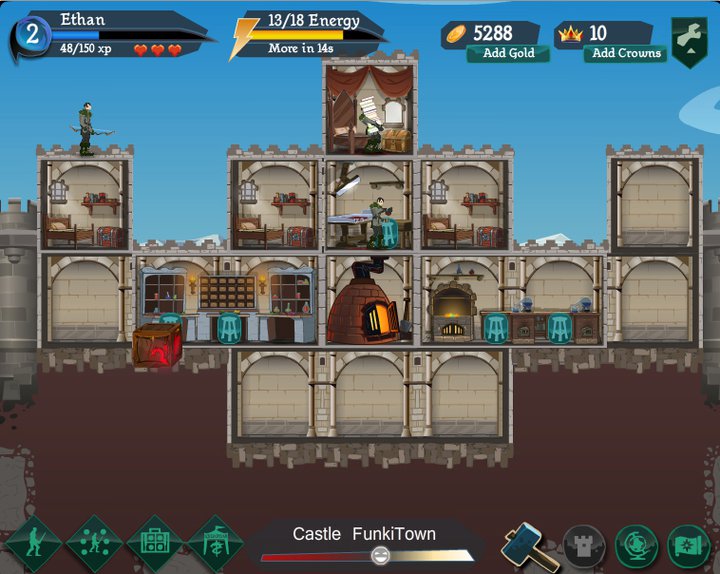
However, Legends also differs from traditional RPGs because the player is actually in control of the supply of consumables, via the castle. The core of a player’s castle are the workshops – the apothecary (for crafting potions), the infirmary (for salves), and the alchemy lab (for bombs) – which can create consumables over certain timed increments. For example, the player can place a worker in the apothecary to create 2 health potions in 30 minutes of real time. Giving players this control frees them from the anxiety of depleting their limited supply of items. With Legends, players can always invest time and gold into their castle to start rebuilding their supply.

Indeed, the two halves of the game – the castle and the combat – create a self-sustaining economic loop. Gold earned from fighting battles and completing quests can be invested into expanding the castle and upgrading its rooms. Accordingly, maintaining the castle and tasking workers to create items provides the potions, salves, and bombs the player needs to defeat the increasingly difficult monsters encountered over the course of the game.

Thus, the two parts of the game fit together and buttress each other. A well-supplied character will lose less battles, earning more gold that can be invested in the castle. A well-maintained castle will create more consumables for the the player to use in combat, increasing the odds of success. The combat and the castle provide context for each other, motivating the player to keep fighting and to keep building.
Dragon Age Legends: Combat Explained

My current game, Dragon Age Legends, was released this week. I wrote the following post as designer notes on the combat system.

One of the most lauded features of Dragon Age: Origins was its tactical combat system, which encouraged players to plan ahead and make interesting choices during battle. Indeed, although the system ran in real-time, the player could set a number of triggers that paused combat, to give time for deciding which skills to use and against which enemies. This feature allowed some to play Origins as almost a turn-based game that emphasized smart tactics over fast reflexes.

The Dragon Age Journeys Flash game built in parallel with Origins brought elements of the franchise to an actual turn-based game, in which battles played out on a hex-based grid. For the new Dragon Age Legends Facebook game, we built on top of what worked within the Journeys system (which itself was based on Daniel Stradwick’s Monsters’ Den Flash RPG).

For example, we borrowed the interleaved turn queues from Journeys, which means that the heroes and monsters take turns one at a time instead of fighting together as alternating groups, as is common in many group-based RPGs. Giving the player knowledge of which exact characters will move next creates some interesting tactical decisions. A monster who will attack sooner might be a better target than one who is a greater threat overall. Skills which disable or freeze enemies can be used intelligently to keep the most dangerous monsters at bay.

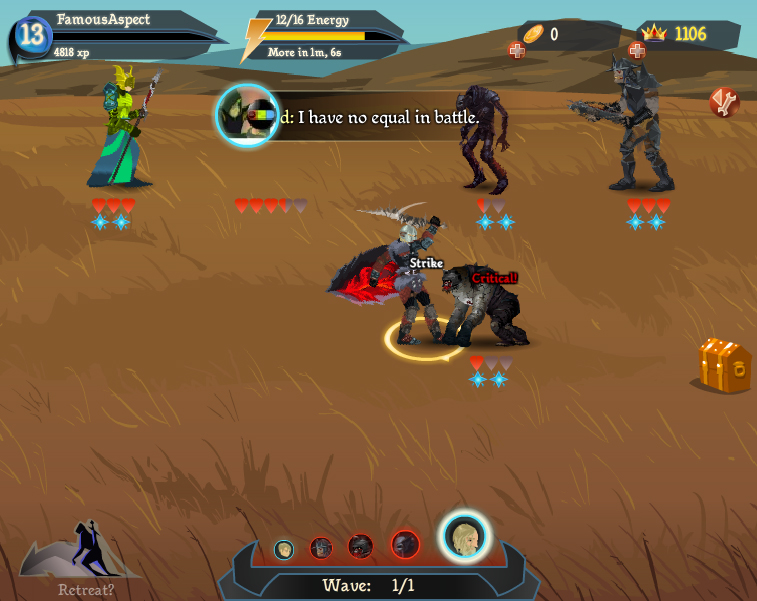
However, we simplified other mechanics from Journeys. Instead of using a hex-based grid, we adopted a simpler layout familiar to fans of Japanese RPG series like Final Fantasy in which the heroes and monsters line up on opposite sides of the screen is static slots. We built a 2 X 3 grid for each side, with front and back columns so that characters in the back column are protected from melee attacks by characters in the front column. This arrangement allows players to plan ahead by attacking a specific monster in the front line that, when dead, would expose a weak but dangerous blood mage in the back.

Another big change involved how we handled health and mana, the two most common stats from RPGs. Instead of using a bar-based system, in which a character might have 45 of 80 health points, we adopted a more chunky icon-based system. A character’s health is represented simply by 4 hearts, which are measured in halves, identical to the health system from the Zelda games. Mana is represented by single icons and as most skills cost just one mana, the number of icons a character has is shorthand for how many skills she can use.

This simplification had a number of advantages. First, the system had much greater clarity than opaque health and mana bars. These bars generally have the same size on the interface for the sake of consistency, which unfortunately obscures their true values. Although one character might have 20 hit points while another has 200, their health bars look the same on the game screen. In fact, most modern RPGs have superimposed text on top of health bars to give the actual values to avoid any confusion. With the iconic hearts, Legends avoids this problem as the graphics do not obscure any game data – what you see is what you get.

However, the most important reason to adopt the icon system is that it gives players a very tangible understanding of the consequences of their actions; the interface tells the exact effect of every possible action. For example, mousing over the “Power Strike” skill button next to a Hurlock shows that the action will take one-and-a-half hearts away from the monster while draining one mana from the player’s character. Mousing over a health potion shows that two hearts will be restored to the character. Mousing over a shock bomb shows that one heart will be taken away from all enemies. This transparency enables the player to plan ahead and make smart moves.

One reason so many RPGs go with a bar-based system is that hits points need to scale up over the course of a game, ranging from 10 hit points for starting monsters to over 1000 for bosses. With icons, Legends can never support hit point values that scale so high because the interface can only show so many hearts. Instead, the underlying character stats – attack, defense, agility, and luck – provide the scaling we need as players progress through the game.

Damage is calculated by creating a simple ratio between the attacker’s attack and the defender’s defense values. As this ratio increases to 2:1, 3:1, and higher, the damage value in hearts goes up. However, if the ratio remains constant, so does the damage. Thus, characters battling with 10 attack and 8 defense do the same amount of damage as characters battling with 50 attack and 40 defense, which means that the relative value of hearts stays the same. Similarly, agility and luck determine the odds of glancing blows and critical hits, by comparing the attacker’s luck with the defender’s agility.

As for mana, most skills cost just one point, with a few costing two and a handful costing more. The skills are all upgradeable up to ten levels (similar to the Japanese RPG Etrian Odyssey), which means that their power increases over the course of the game. However, their costs do not, so that players can expect to use the same number of skills per battle through all phases of the game. The costs can remain fixed because the better skills are simply an extension of the character’s growing power as he levels up.

Thus, the game’s simple and discrete health and mana values are maintainable across the game’s various levels. The players quickly gain an intuitive sense for how the game works (“shard bombs do one-and-a-half hearts of damage”) without having to memorize formulas or manage large, crooked numbers. Being able to think in small increments – a point here, a couple of points there – allows the player to fit a whole battle into her head at once, making combat a fun, tangible experience instead of a chaotic, stressful one.